

In 2026, minimalism is no longer a stark white-room aesthetic reserved for design magazines and tidy-minded influencers. It has become something more practical, more human, and in many ways more hopeful. Across crowded cities and quiet suburbs alike, people are opening their closets, their calendars, and their bank apps and asking a simple question: What if life felt lighter?
The answer, for a growing number of people, is minimalist living. Not a life of deprivation, but one of intention. Not emptiness, but breathing room. From compact apartments in Tokyo to sunlit studio flats in Lisbon, from family homes in the American Midwest to shared spaces in Berlin, the minimalist mindset is spreading because it meets the moment. In a world that feels louder, faster, and more expensive than ever, less is beginning to look like freedom.
The weight of too much
Many people arrive at minimalism after a long season of accumulation. The drawer stuffed with old cables. The shelf lined with decorative objects nobody notices. The wardrobe full of clothes that seem to belong to a different version of yourself. The calendar packed with obligations that leave little room for rest. By 2026, the burden of excess feels especially visible. Housing costs continue to climb in many places, consumer culture has become relentless, and digital life often delivers an endless stream of things to buy, compare, and replace.
This is where minimalist living begins to feel less like a trend and more like a practical response. A smaller home can mean lower rent, lower utility bills, and less time spent cleaning. A smaller wardrobe can mean faster mornings and fewer impulse purchases. A less crowded schedule can mean more energy for work, family, travel, and the ordinary pleasures that too often get pushed aside. The appeal is not abstract. It is tactile. It is the relief of an uncluttered kitchen counter at sunrise, the calm of finding what you need without digging, the quiet satisfaction of owning fewer things that matter more.
In many ways, people are not choosing minimalism because they have fallen in love with absence. They are choosing it because they are tired of being owned by abundance.
Money, space, and the new math of living
One of the strongest reasons for the rise of minimalist living in 2026 is simple economics. For many households, the cost of maintaining a traditional consumer lifestyle has become increasingly difficult to justify. The modern home can swallow money in invisible ways: storage bins, subscriptions, trend-driven purchases, furniture upgrades, gadgets that promise convenience but add clutter. Minimalism offers a different equation.
When people buy less, they often save more. When they live in smaller spaces or furnish them more intentionally, they may find themselves with lower overhead and fewer long-term obligations. This matters not only to young professionals and students, but also to families, remote workers, and retirees seeking stability. Minimalism can create financial breathing room, which in turn creates emotional breathing room. A person with less debt and fewer recurring purchases often has more flexibility to travel, to change jobs, to spend time with loved ones, or simply to weather uncertainty without panic.
There is also a cultural shift at play. The old status symbols are losing some of their shine. In place of visible accumulation, people are increasingly valuing the invisible comforts: flexibility, resilience, and peace of mind. A pared-down life can feel quietly luxurious in a way that expensive clutter never quite manages.
The digital overflow
If earlier generations struggled with packed closets and overflowing garages, 2026 has added a new frontier of clutter: the digital world. Email inboxes, cloud storage, app notifications, streaming choices, social feeds, work messages at all hours — the modern mind is often asked to hold too much at once. Many people are turning to minimalist living as a way to reclaim attention, not just space.
The shift starts with small acts. Deleting unused apps. Turning off notifications. Unsubscribing from newsletters that shout rather than speak. Choosing a handful of trusted sources instead of endless scrolling. These habits may seem modest, but together they create a kind of mental architecture. Less digital noise can make room for deeper focus, more restful evenings, and conversations that are not constantly interrupted by a glowing screen.
For younger adults especially, who have grown up in the center of the attention economy, minimalism can feel like a form of resistance. It asks them to be selective in a world that rewards constant engagement. It encourages them to notice the difference between what is useful and what is merely stimulating. In that sense, minimalism in 2026 is not only about belongings. It is about reclaiming the mind from a thousand tiny demands.
Travel, mobility, and the appeal of lighter living
There is something especially attractive about minimalist living to people whose lives are increasingly mobile. Remote work, hybrid schedules, and international job opportunities have made it easier for some to move between cities or even countries. The more portable life becomes, the less sense it makes to be weighed down by possessions.
Imagine a traveler in a compact apartment overlooking a tram line in Prague, or a freelancer working from a bright one-bedroom in Medellín, or a couple splitting time between a coastal town and a city studio. In these lives, every object has to earn its place. Minimalism is not just a philosophy; it is logistics. A streamlined wardrobe, a multipurpose kitchen, a home designed for ease rather than accumulation — these choices support a lifestyle that values movement and adaptability.
Even for those who do not cross borders often, the desire for mobility has seeped into everyday thinking. People want homes that can change with them, not homes that trap them in a pile of purchases. The minimalist approach offers that flexibility. It makes space for transitions: a new job, a new relationship, a baby, a move, a long season of uncertainty. When life is light enough to carry, it becomes easier to go wherever it leads.
Wellness, calm, and the beauty of less
Minimalist living has also grown alongside the broader wellness movement, but it speaks in a quieter voice than many of its glossy counterparts. Rather than promising transformation through products, it suggests that well-being may come from subtraction. Fewer items, fewer commitments, fewer distractions. More rest. More presence. More room to notice the texture of daily life.
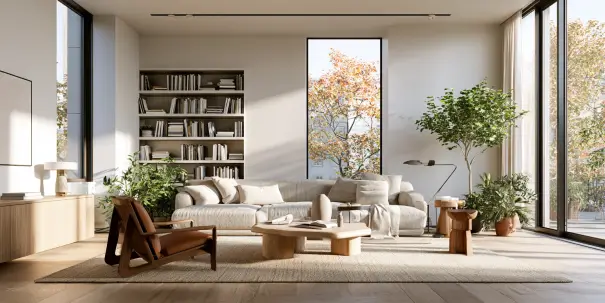
People often describe a minimalist home as calm, but the appeal goes beyond visual simplicity. It is the feeling of entering a room where nothing competes for attention. It is the ease of preparing breakfast in a kitchen that is not overfilled with gadgets. It is the softness of a bedroom designed for sleep rather than storage. These environments can support better routines, more mindful habits, and a slower pace of living.
There is a sensory beauty to minimalism that often gets overlooked. A single ceramic bowl on a wooden table. Light crossing an empty floor. Linen curtains moving in a warm breeze. The absence of excess can sharpen the details that remain. In this way, minimalism can resemble travel itself, where the unfamiliar strips away routine and makes the world feel newly visible.
Environmental awareness and the ethics of owning less
Another reason minimalist living is gaining momentum in 2026 is environmental concern. More people are asking where their belongings come from, how long they last, and what happens when they are discarded. Fast fashion, disposable home goods, and low-quality consumer products have left many feeling uneasy about the cycle of buy, use, toss, repeat.
Minimalism offers a gentler path. Buy fewer, better-made items. Repair what can be repaired. Choose durable materials. Let objects age with dignity. This approach does not solve every environmental problem, but it aligns personal habits with broader sustainability goals. It encourages a slower relationship with consumption and a greater respect for the resources embedded in everyday things.
For some, this ethic extends into food, travel, and community life. They are choosing local markets over constant delivery, train journeys over quick flights when possible, shared tools over duplicate ownership, and experiences over souvenirs. Minimalist living, at its best, becomes a kind of stewardship. It asks not only what we can afford to own, but what we should bring into our lives at all.
Aesthetic minimalism versus lived minimalism
Of course, not every version of minimalism is the same. Social media has often presented a polished, highly styled version of the lifestyle: monochrome interiors, immaculate shelves, perfectly edited wardrobes, and an almost museum-like stillness. That image can be appealing, but it can also be intimidating. Real minimalist living in 2026 is more varied, more lived-in, and more forgiving.
Some people practice what might be called functional minimalism. Their homes are not empty, but everything has a purpose. Others lean into family minimalism, where children’s toys, school papers, and everyday mess coexist with a commitment to reducing excess. Some embrace digital minimalism more than physical minimalism. Others focus on time, energy, or emotional boundaries. In practice, minimalism is rarely about achieving a perfect visual standard. It is about making deliberate choices that support the life you actually live.
This distinction matters because it opens the door to more people. Minimalism does not have to mean cold interiors or severe rules. It can be warm, colorful, and personal. A handwoven blanket thrown over a simple sofa. A shelf of beloved books. A kitchen with one excellent pan instead of six mediocre ones. A life edited for ease, not stripped of personality.
How people are starting
For those curious about minimalist living, the path usually begins with one corner of life, not the whole house. A drawer. A closet. A desk. The goal is not to create emptiness overnight, but to notice what is redundant, broken, or unused. From there, momentum builds. People often report that once they see the benefits in one area, they naturally begin simplifying others.
Common starting points include:
- Reducing clothing to pieces that are worn often and feel good.
- Clearing kitchen tools to keep only the items used regularly.
- Reviewing subscriptions and canceling what no longer adds value.
- Setting limits on digital notifications and screen time.
- Creating open space in one room as a visual and mental reset.
What matters most is that the process feels sustainable. Minimalism tends to work best when it is not performed as a purge, but practiced as a habit. The question shifts from What can I get rid of? to What deserves a place in my life?
The social side of living with less
One of the more surprising developments in 2026 is how often minimalism is becoming communal. Friends are swapping items instead of buying duplicates. Neighborhood groups are creating tool libraries. Families are sharing storage, childcare, and meals in ways that reduce both cost and clutter. In cities where space is expensive and time feels scarce, these shared solutions are especially powerful.
Minimalist living can also reshape relationships. When people are less preoccupied with acquiring and maintaining things, they may have more room for gathering, conversation, and hospitality. A simple meal can feel more generous than a complicated one. A living room with enough open space for guests to linger can matter more than a room filled with expensive decor. In this way, minimalism is not a retreat from life. It can be a return to it.
There is also a subtle emotional honesty in this lifestyle. Owning less can reveal what we actually value. Some people find they care deeply about books, music, plants, or travel gear. Others discover that what they most treasure is time. By removing the nonessential, they create a clearer picture of their own priorities.
Why 2026 feels different
Minimalism has existed in various forms for years, but 2026 feels like a turning point because so many pressures are converging at once. Economic uncertainty, climate anxiety, digital overload, shifting work patterns, and a growing skepticism toward overconsumption have all made the case for less more persuasive. People are not simply following a style. They are adapting to a reality that demands resilience.
That is why minimalist living is resonating across ages and lifestyles. It offers a way to simplify without surrendering comfort, to save money without feeling deprived, to create beauty without filling every surface. It suggests that a good life may not be one of endless addition, but of careful selection.
On a quiet evening, in a room with only the things that matter, the idea can feel almost radical. The air seems wider. The light has somewhere to go. The mind, no longer tripping over excess, can wander a little farther. And perhaps that is the real reason more people are choosing minimalism in 2026: not because they want less life, but because they want more of it.